Is it real? and how are we receiving the image is the core of the weeks’ investigation. These two aspects play together well. There are images out in the wild that are accepted not because they are trying to impose fake images but because we have the pre-knowledge that it is not real. The example we are provided is Joel Peter Witkin’s image of a centaur. We know that there has been no proof of the centaur existing and this image is not trying to prove this fact, so is accepted and not challenged. Even though this goes against the accepted view of objectivity supported by Roland Barthes who states ‘ Painting can feign reality without having seen it.’ and goes on to say ‘Contrary to these imitations, in photography, I can never deny the thing has been there.’1 (Barthes, 2000,76)
Once the reality of the image has been put to one side then the icons within the image can be viewed to allow the reading of what the practitioner was conveying with the image.
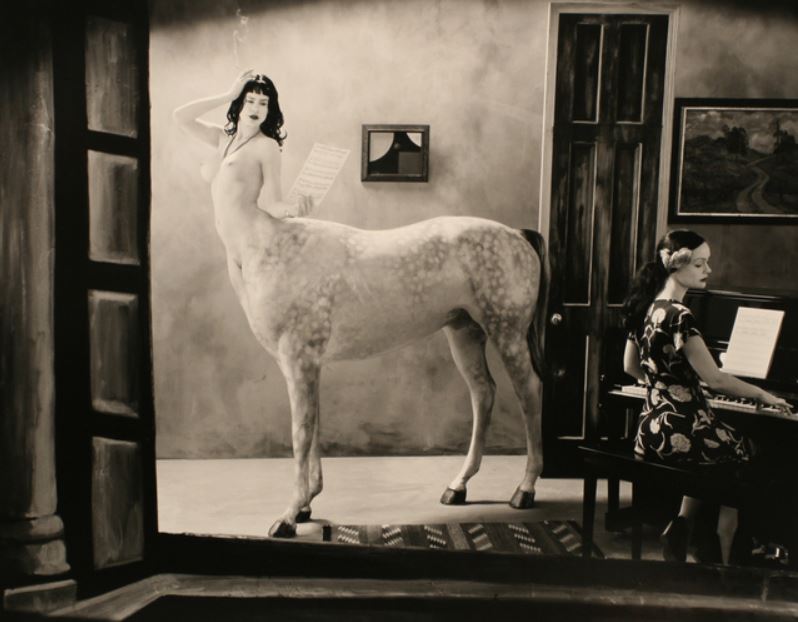
With the photographic image being perceived as more objective and less able to be subjectively tampered with, as possible with a painting, it would make the above image seem more appropriate as a painting and not a photograph.
When looking into the veracity of images, a direct comparison between painting and photography, leads me to the conclusion that it is certainly more feasible that a photograph is more valid in the terms of accuracy due to the objectivity of the process. Thomas Struth’s work in the gallery shows people looking at the Las Meninas by Diego Velazquez.
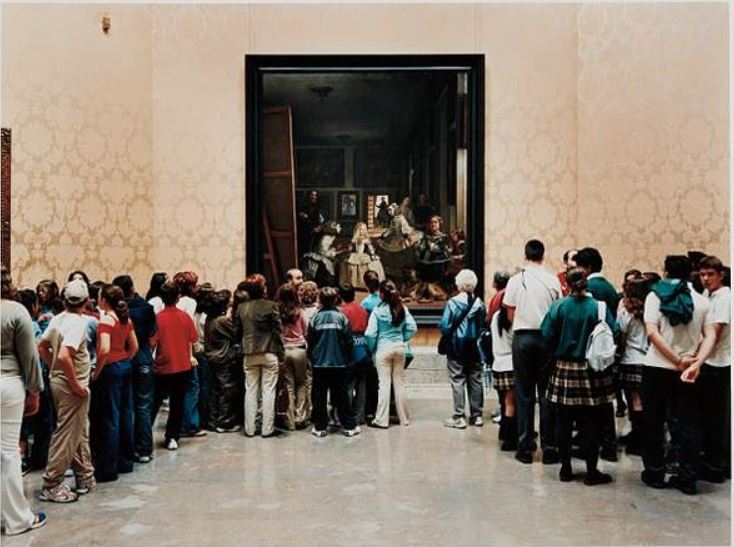
This photograph plays on what Michel Foucault reminds us, ‘We are looking at a picture in which the painter is in turn looking at us.’2 However with no knowledge of the content of the picture that interplay may be lost. The details of the photograph do not reveal this clearly. If we study the photograph there is no reason to doubt the veracity of the image. As a viewer, I can feel that I am in the room seeing exactly what is depicted. On studying the painting it would not be possible to be the painter looking into the image as we do as he is presently looking out. This would only be possible if it were a mirror before him, This is not possible due to the mirror on the back wall. These facts destroy the authenticity of the painting as an objective image.
Foucault has highlighted other images from artists such as Edouard Manet showing the impossible position for the viewer or painter. When reviewing “A bar at the Folies-Bergere” he explains ‘Manet plays with this pictures property of being not in the least normative space’. 3 So if paintings are not in normal space then they can not be objective and have to be subjective and coming back to the premise that they are not real.
For other posts this week Index and the Icon Post
Figures
1 https://www.artsy.net/artwork/joel-peter-witkin-night-in-a-small-town-new-mexico-1
2 Thomas Struth Museo del Prado Room 12, Madrid, 2005-2009 https://www.phillips.com/article/6911584/thomas-struth-museum-photographs
Bibliography
1 BARTHES, Roland. 2000. Camera Lucida. London: Vintage.
2 Foucault Michel. 1994. The Order of Things. (Vintage Books edn). USA: Random House, Inc. New York.
3 Michel Foucault. 2009. Manet and the Object of Painting, Translated by Matthew Barr (London, Tate, 2009; 2011). p79


