The post Artist: Andreas Feininger appeared first on MA Photographic Journey.
]]>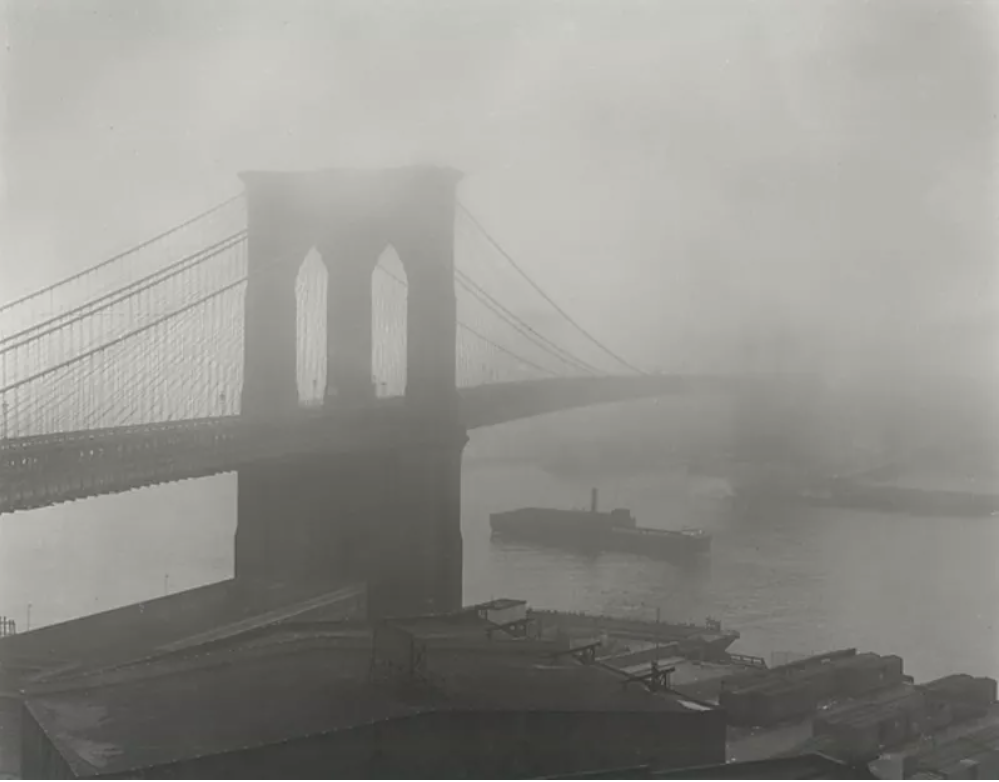
The above image shows how the scale of the bridge is emphasised by the boat going under the bridge. We all perceive the size of the boat which allow us to comprehend the bridge. Using a smaller focal length nearer to the bridge would distort and reduce the size and give a false perspective, however, that is possibly what we would more relate to with the more common focal lengths.
This principle is something that I feel is often overlooked, or often forgotten. I know that I am guilty of this. Remember all the features of the lens that you use.
Feininger’s principle lens, which he discusses, is 40″ which would work out just over 1000mm which is certainly not typical for landscape photography, Maybe more at home with wildlife or sports.
The landscape images stand out not because they are of new things or locations but because he has moved away repetitive images of things we have all seen.
Feininger also utilises the long focal lengths in the creation of more abstract art in the miniature utilising shells and other small objects, again showing that a long lens can be used for more than one application.
I take from this the reminder that we have the tools and remember to use them to their most.
Images
Figure 1 Andreas Feininger https://www.artsy.net/artwork/andreas-feininger-brooklyn-bridge-in-fog-1
The post Artist: Andreas Feininger appeared first on MA Photographic Journey.
]]>The post Artist: Penelope Umbrico appeared first on MA Photographic Journey.
]]>Umbrico has not stopped with sunsets, utilising the process has created works based on full moon images and TV remotes. I find that the sunset images work well with the colours blending and contrasting. In looking at the image I find that it enters a “eye” game as you explore the surface moving along the lines before being stopped by a colder image which moves the eye in a different direction.

As abstraction I find this a great piece as although the image allows the individual referents to be seen clearly, however the overall work creates a new non referent image.
With the concept of appropriation in mind, I produced an image of the Eifel Tower with images found online. This image is produced in the multiple exposure method, as discussed in the post regarding Pep Ventosa. So

Reference
REXER, Lyle. 2013. The Edge of Vision. (First paperback edition edn). New York: aperture.
Figures
Fig 1 Suns from sunsets on Flikr http://www.penelopeumbrico.net/
Fig 2 Roydon Woodford 2021
The post Artist: Penelope Umbrico appeared first on MA Photographic Journey.
]]>The post Artist: Ilan Wolff appeared first on MA Photographic Journey.
]]>Ilan Wolff has established a large body of work using the ‘Camera Obscura’ or pinhole camera. His career has spanned decades with work produced around the globe.
He utilises various sizes of canisters and tubes to produce his images, The curvature of the can, which causes the film to curve together with the large field of view produces an optical warp in the finished image. This look is something that helps identify the process.
Studying Wolff’s images in relation to my own have shown that more consideration is required with the composition. I have understood the wide angle nature of the camera however I have established that my foreground items were still too far away reducing them a small blip in a vast image.
I feel that in viewing Wolff’s work allows one to gain insight and utilise the years of experience from someone who has mastered the craft of camera obscura.
The image below is Wolff’s experimentation with 3 holes in the camera tube producing an overlapping image is a further process that I have started to explore.

One aspect of Wolff’s work that does stand out is the use of colour toning introduced in the darkroom processing of the images. Although this dramatically enhances the finished result it is something that will be beyond me in the current facilities that I have for processing images, however if there is a change in circumstances it would be something to undertake.
References
Figures
Fig 1 Ilan Wolff Minster Bridge. https://www.ilanwolff.com/photography-for-sale/3-pinhole#sigplus_1001-12
The post Artist: Ilan Wolff appeared first on MA Photographic Journey.
]]>The post Artist: Bill Armstrong appeared first on MA Photographic Journey.
]]>Bill Armstrong has established a strong presence in the abstract workspace. The work spans decades and is represented in several galleries globally including the Hackelbury Fine Art in London.
The most recent book produced is Isolation and Confinement with essays that cover various individuals either incarcerated of isolated due to a pandemic. His use of his work on the cover clearly shows the feelings that can be associated with the title.
I find that the work that I appreciate the most is his Mandela series. The Mandala has strong links to the Buddhist religion, Based on repetitive patterns that relate to the themes of Buddism. His work often out of focus works well with the collage that reduces the circles. Revealing strong passionate and colourful images.
In his own words, he explains what he is aspiring too, ‘allows me to create rhapsodies of color that change as one gazes into them: they pulsate as if alive. This sense of “being” within the inanimate invites an inquiry into the idea of the interconnectedness of all things.
Whether seen as celestial spheres, imaginary objects, or microscopic details, the Mandalas are meant to be meditative pieces–glimpses into a space of pure color, beyond our focus, beyond our ken. Their essential purpose is to create a sense of transcendence, of radiance, of pure joy!’1

Bibliography
- https://www.billarmstrongphotography.com/mandala-page-info
Figures
#4002, 2016 https://www.billarmstrongphotography.com/mandalas
References
REXER, Lyle. 2013. The Edge of Vision. (First paperback edition edn). New York: aperture.
The post Artist: Bill Armstrong appeared first on MA Photographic Journey.
]]>