The post Week Twelve: Looking Both Ways appeared first on MA Photographic Journey.
]]>The Oral presentation is done and marked the research proposal submitted along with the work in progress images. (http://roydonwoodford.co.uk)
The title reflects where we are. The module PHO701 has closed with the introduction to Informing Contexts, the next module. So it’s time to reflect on Positions and Practice and start to prepare. There is no let up and although the next module starts in late January we have a small snow capped mountain to ascend before then.
The take away from this module, that any practice that is not a producing redundant image needs context. This context may be the method of display or location of display or reason to exist as an informative image. With greater knowledge of the subject, and research in terms of planning, outcomes, possible collaboration partners, supporters projects can be undertaken with more success.
Creating a project proposal covering the next three modules has mapped out a path to follow and has become a guide to stay on track. I feel that it has also allowed foresight of possible hurdles that will need to be addressed.
To use Shakespeare, “I say, there is no darkness but ignorance”1 applies to photographic practice. Ignorance of the works of others leads to a darkness which negates the ability to see. This position demonstrates that this is about building a basic vocabulary of images and an solid base of theoretical knowledge to raise the darkness and provide the light. So read, read, read, take notes and read some more.
Contributing to forums and the topics explored each week have lead to a much greater understanding of photographic practice. When you have a group of peers reviewing an image or discussing a particular subject the plethora of ideas that come forward that expand the possibilities. Taking the “blinkers off”. Showing many more aspects means that you need to stop and see the image or topic, without assumption. Research ideas one has before leaping to conclusions. This is brought home during week 5, Power and Responsibility while discussing Jeff Mitchells migrant picture.
My conclusion, “We have already seen that once an image has been released the photographer has little control over its use especially when the release is to a corporation who has the sole intention of selling the picture. I feel that Jeff can not wash his hands as he has the choice of where they are placed.” is deleted when it comes to light that Jeff Mitchell was employed by the agency and had been tasked to take the images. Had I reviewed Jeff’s background this may well have been apparent.
There have been many comments regarding the CRJ, people not wanting to do it and although I do not find it the easiest part of the process, often finding that I am merely documenting events. I have to admit that it is becoming easier and has a lot of value to me. There are better ones but this one is mine.
Biblography
SHAKESPEARE, William. 2000. Twelfth Night. South Bend: Infomotions, Inc.
The post Week Twelve: Looking Both Ways appeared first on MA Photographic Journey.
]]>The post Week Nine: Proposal and Audience appeared first on MA Photographic Journey.
]]>The type of audience may dictate the method of engagement such as what options are available to a practitioner so the right choices are made. As a suggested reading for the week, Ways of Curating, Hans Obrist leads us on a path of alternative exhibition space with the use of a kitchen which evolves over time.
‘I didn’t have access to an exhibition space in a gallery or a museum, of course, but I did rent an old flat in St Gallen. I never cooked. I never even made tea or coffee because I always ate out. The kitchen was just another
space where I kept stacks of books and papers. This was exactly the feature that Fischli, Weiss and Boltanski had independently noticed. The non-utility of my kitchen could be transformed into its utility for art.’1
I feel that this highlights the need to explore what is available and suitable for any body of work produced.
Exhibition in a gallery or production of a book may not be the most suitable installation or means of dissemination. Would the context of the work mean that it is more suitable for a display along an old wall? Maybe taped to lamp posts? Can social media be used to disseminate the work or publicise information? If so how will you build a sizable following so that your work has a reach?
This examination of who and where a practitioner will find their audience will allow for clearer understanding, which, will enable this to be communicated in any project proposal. As a result, this could be considered as one of the last major milestones of the project. So without this milestone, the project may stumble, never reach completion.
Bibliography
1 OBRIST, Hans Ulrich. 2014. Ways of Curating. (First American ed. edn). New York: Faber & Faber.
The post Week Nine: Proposal and Audience appeared first on MA Photographic Journey.
]]>The post Week Eight: Practitioners Context and Gallery Creation. appeared first on MA Photographic Journey.
]]>Practitioners may choose a delivery method to contextualise their work as we have seen with the ‘kitchen’2 being used as a pop-up gallery. For the assignments of work in progress, options are more limited to online gallery or PDF.
Having spent time researching galleries and other practitioners I feel that most of the images are displayed grouped horizontally for example Stephanie Jung or in block arrangements but always bold and uncluttered. No fancy backgrounds.
Extensive exploration of various options for gallery production. Portfoliobox, Adobe to name but two. Adobe although free as part of the subscription is very tied and limited with what you can do but on a plus side image transfer to the Adobe platform is a simple process from Lightroom.
Portfoliobox, a competitive alternative to Wix and many others offers a range of set galleries which is worrying that it leads to a lot of the same for the viewer.
In conclusion, the best option would be to utilise a WordPress site where I have full control. Simple installation and away we go. This option allows for changes and modification to whatever I feel I need.
Good progress within the cohort regarding feedback. The group in a whole is starting to give constructive feedback to one another. No longer just commenting “I like your pictures” but offering options to possibly improve what is being displayed. Through the discussion groups and webinars, I personally felt happier offering advice but also pleased with the advice I received. Creating more space around my images, as suggested improved the overall aesthetics. This then allowed for a fine border and shadow to individualise each image. Clearly, the gallery is much improved because of the discourse during the week.
Biblography
- COTTON, C., 2009. The photograph as contemporary art. New ed. edn. London: Thames & Hudson.
2. OBRIST, H.U., 2014. Ways of curating. First American ed. edn. New York: Faber & Faber.
The post Week Eight: Practitioners Context and Gallery Creation. appeared first on MA Photographic Journey.
]]>The post Work In Progress PHO701 appeared first on MA Photographic Journey.
]]>[foogallery id=”315″]
The post Work In Progress PHO701 appeared first on MA Photographic Journey.
]]>The post Week Seven: Peer Commissioned Micro Project appeared first on MA Photographic Journey.
]]>Stage one of the exercise was to create a brief for a peer while they create one in return. The brief required restrictions based on the weeks’ discussions. Partnered with Steve Rabone we engaged to discuss what was possible with outside commitments. I would be working at the lifeboat station for the following days and with that in mind Steve put forward a brief to photograph behind the scenes. As part of my brief to Steve, I had asked for 7 images so to level the field he asked for the same.
[foogallery id=”228″]
I felt that I would attempt a series of selfies of the work that I undertook at the station.
At the start I had no pre-ideas about the output of the images however in post black and white pulled the images together as a collection or series. To undertake this style of work I would prefer not to use myself as the limitations of using a remote and limited position a tripod could be used.
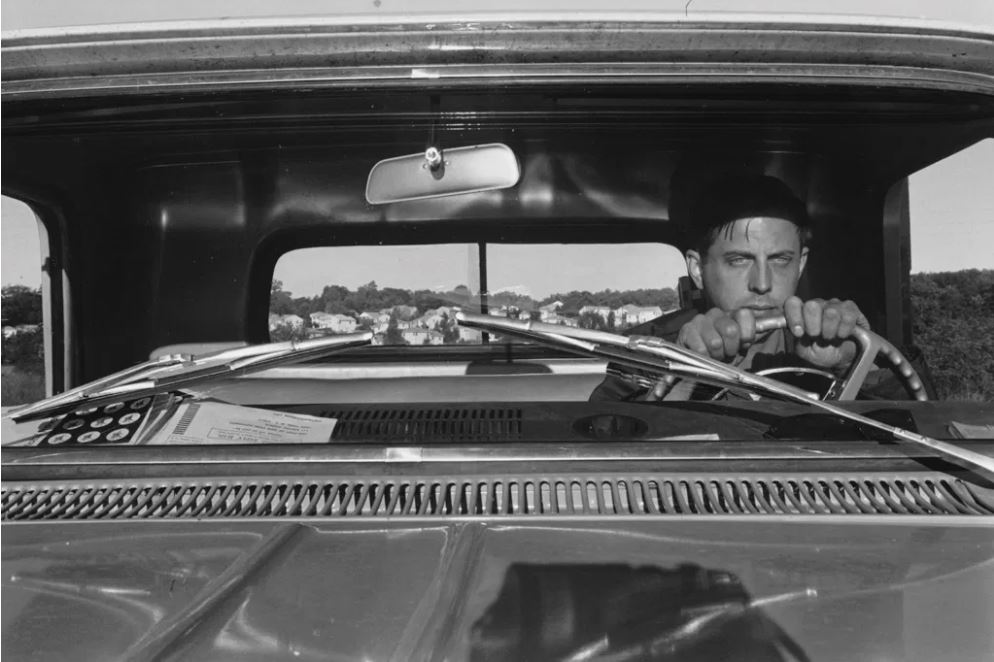
I find the results resonate with the work of Lee Friedlander in his series of self portraits with a direct comparison to the 1966 print titled Haverstraw, NY which depicts Friedlander at the wheel of a car. His work in the series expands away from the simple self portrait utilising shadows and reflections to create a more diverse body of work than I produced.
Robert Mapplethorpe is another example of a practitioner that I feel has adopted the use of self-portraits to create a series with a sense of style and fun early on, the later longer exposure, showing signs of confusion in old age. I can see that the technique can be effective in the creation of images and without the constraints of the location of the brief I may well investigate this further in the future.
The post Week Seven: Peer Commissioned Micro Project appeared first on MA Photographic Journey.
]]>The post Week Six: Chance appeared first on MA Photographic Journey.
]]>Modern technology allows a myriad of shots to be captured within one second. So are these photographers relying on the chance or luck presented? with the rapid-fire of the modern DSLR, 6-12 frames per second, the shot before the buffer is full and then miss the next?
I have the feeling that these photographers are doing just that using the luck and chance just to get the next shot. If it was technical only one camera would need to be present. This shows that in any practice there has to be chance or luck, The luck is maybe which side of the field you’re at and the chance is you started depleting your buffer at the right moment.
With the abstract practice that I am currently working on, I have to accept that there are times when luck can have a helping hand as I clearly feel others have the same luck. Often one can have the visualisation of the image you want to achieve, but, Unless external factors fall into place the practitioner may not ever get the image.
Baldessari takes chance almost as his brief. The ‘Car colour series’ I feel is inspirational use of chance. Taking images down one side of the street of the parked cars. In itself, this series would not stand out as anything more than colour cards. It’s in the installation for viewing the series that brings it together as art, with spaces left where no car was parked is the significant factor that makes the series work. This is certainly an aspect to remember in that it may not be the one image that is the work but all the images, A reminder of Jeff Wall’s work using many images to create one picture.
The post Week Six: Chance appeared first on MA Photographic Journey.
]]>The post Positions and Practice PHO701 Block S1 Oral Presentation appeared first on MA Photographic Journey.
]]>PHO701 Oral Presentation as part of module Positions and Practice.
Bibliography
In Praise of Shadow 980726, 1998 Hiroshi Sugimoto https://www.sugimotohiroshi.com/new-page-44
Houses of Parliament Claude Monet Claude Monet, CC0, via Wikimedia Commons
https://commons.wikimedia.org/wiki/File:Claude_Monet,_Houses_of_Parliament,_London,_1900-1903,_1933.1164,_Art_Institute_of_Chicago.jpg
Bathers 9 Paul Cezane https://www.paul-cezanne.org/Bathers-9.html
Reclining Nude Gerhard Ricter 1967
https://www.gerhard-richter.com/en/art/paintings/photo-paintings/nudes-16/reclining-nude-15560/?&referer=search&title=reclining+nude&keyword=reclining+nude
Fate of the animals, Franz Marc, 1939, https://www.franzmarc.org/Fate-of-the-Animals.jsp
Shell-shocked Marine 1968 Don McCullin https://www.tate.org.uk/art/artworks/mccullin-shell-shocked-us-marine-the-battle-of-hue-ar01201
Erhai Lake, Study 7, Yunnan, China. 2013, Micheal Keena, https://www.michaelkenna.com/gallery2.php?id=11
diego_torres https://pixabay.com/p-2004440/?no_redirect=
Uncredited images – Roydon Woodford
PHO701 Oral Presentation as part of an accredited masters course with Falmouth University. https://www.maphotographicjourney.co.uk/uncategorized/oral-presentation-copy/
The post Positions and Practice PHO701 Block S1 Oral Presentation appeared first on MA Photographic Journey.
]]>The post Oral Presentation Copy appeared first on MA Photographic Journey.
]]>Welcome to my oral presentation for the positions and practises module of the MA photography course, My name is Roydon Woodford and I will introduce my current practices and my plans for a research project. That’s me aged about 7 on the roof of my Grandads boat.
This is me more recently hanging off the side of a lifeboat, this allows me to capture shots like this.
There are strict rules within the RNLI about the use of cameras during shouts as some of the situations can be macabre and warlike or when at the time for action is required there is no spare seat for a photographer. However, there are many aspects of the lifeboat crew that can be captured. My access to these situations creates more decisive images with the crew member having fun training or the harrowed look after the experience of a shout. The type of image often seen in the war reporters work such as Don McCullin. A future project is to capture the life of crew members at work, at home with families, training The what’s behind the RNLI however, even with individuals agreement this work requires the agreement of the RNLI.
A larger area of my practice is landscape and seascape photography, with the Jurassic coast as inspiration. Frequently it is about sunrise or sunset in dramatic Dorset locations. However, my work is not just at the behest of the sun.
Roland Barthes deconstruction of images leads to an aspect he calls studium. The pretty, the usual, the known and I feel that my landscape work to date however pretty or colourfull falls directly into this group, it has become nothing more than collecting pictures of what was, with a simple press of a button. Always avoiding people to distract from the beauty of nature. Each day a replication of the same image with a different sky or wave splash.
Photographers descending to Dorset to collect the same set of images with no visual interpretation of their own. Collecting next sunrise just to gain a brief exposure to the social media junkies with another pretty picture
My longer exposure work is used in a myriad of ways to extend the visual experience to produce stronger images. The simplistic isolation of the groyne. Leading the viewer into the image of nothing. I believe that this work has more behind it with the intention of raising questions like where is it going? What’s out there? So maybe engaging with the viewer more. Michael Kenna extends this canvas with the reflection that becomes part of the isolated branch.
Adding depth and further dimensions to the stretched wide-angle shot of the pier. Is the dimension time?
The longer exposure is capturing time as it passes the lens. Is this what we see when we look at the streaking clouds, the static image having life breathed into it?
I feel that this aspect of my practices captures the life, with streaking clouds, being part of time.
The waterfall, seeminly paused in an instant, collecting time with the assimilation of water drops creating an image that was never there creating what some would concider an abstract image. Which I feel is supported by Barthes statement,
“the important thing is that the photograph possesses an evidential force, and that its testimony bears not on the object but on time.”
Hiroshi Sugimoto work with the candle, where he photographs the life of a burning candle. Is this photograph valid? Is my work vaild if it can not be seen? As Hiroshi Sugimoto states “However fake the subject, Once photographed, it’s as good as real.” and I have to agree, with the application of time, the validity is confirmed showing that long exposure can create an image never possible in an instant.
Storm chasing is dramatic when successful still requires long exposure. The human eye cannot see a bolt of lightning it merely thinks it has been seen however when captured in a photograph the whole bolt is revealed. Clearly you can see the the image so for my work the bolt of lightning is real as is my image.
With only a few weeks exposure to the MA course my perception of my own practice has been dramaticlly altered away from the repeative landscape to produce very different images. Taking images, looking for the reason the image exists beyond the pretty that I have done so well in the past. Finding a direction.
For the research project I have a working title of “a pipe no longer a pipe” rejecting Barthes view that the referent of an image will always remain within the image and that a pipe is a pipe.
During history there are distinct periods of painting such as the detailed work of Caravaggio in the 17th century through to impressionists such as Claude Monet. Monet’s Houses of parliament I feel moved him away from pure impressionism to approach a more abstract image. Paul Cezanne another painter from the same period whose work I feel started the building blocks for the transition from the more accepted painting of the 19th-century and the bright new world of the 20th-century. I find the bathers 9, more abstract than many of his other works possibly allowing the abstract work that followed during the 20th- century with artists such as Gerhard Richter who’s reclining nude shows the now more common abstract art which artists such as Jackson Pollock and Paul Klee, embraced taking abstract to completion. The fate of the animals in 1939 by Franz Marc, showing the use of bold and strong colours creates a painting that allows the person viewing to take away their own meaning from the image. This transition from fine art landscape to abstract is the progression of my practice and where I see my work heading producing images in the more abstract nature.
Further inspired by the song “windmills of the mind” with “Round like a circle in a spiral, like a wheel within a wheel” with the line “Like the circles that you find in the windmills of your mind!”. This song invokes strong imagery for each person that participates in the song, in their own way how does one see the windmill in the mind? Is it clear or is it distorted like in a dream state? how does one see the wheel within the wheel moving forwards? The song reflects time or the passage of time which is where I feel there is a strong link to the long exposure photography that I undertake.
Utilising long exposure to engage the viewer to be participatory in the meaning the image. The images are not clear photographs and nor fine art they are images that create a mental picture for the viewer, but until the viewer has participated in the picture, the picture has no meaning for them.
From the work of Sugimoto and my work, it is clear that photography and visual perception can be manipulated by the application of time I see a very viable project. The extra punctum as described by Barthes.
The project is not confined to 35mm, it allows for other mediums such as camera-less use of photographic papers and pinhole photography. The images produced can be abstract by nature or with manipulation become abstract.
I see further research into how people percieve images and the effect of colours or images with moods and feelings .
I intend to undertake this in my local area of Dorset to minimise my impact on the environment
Thank you for listening to my presentation
The post Oral Presentation Copy appeared first on MA Photographic Journey.
]]>The post Week Five: Power and Responsibility appeared first on MA Photographic Journey.
]]>Looking at my own practice in reference to the ethical position I felt that there was limited ethics involved. Based heavily on landscape and seascape unless you look at the image production aspect. This raised comments from others fronting that there could be a lot more to consider. I can agree that there are areas where landscape images can be used for interpretation by third parties, the example presented to me “the ramblers association vs the NFU, something that one shot could provoke a reaction from a contentious issue over access.”, However, my practice has not been placed in the position of an image being requested for reproduction so personally, it is not relevant as a consideration. In the event of such a request then clearly the ethical considerations would have to be evaluated based on the request.
One aspect that I had not perceived to think about that was raised was the impact that photographers can have on the environment. Not being one to damage the environment I have often been dismayed by the damage visiting photographers make in our area. Poppy season the farmer’s fields trampled, Bluebell season woodland area destroyed. This opens a whole new way of experiencing the ethical debate, it’s not about the image and what happens to it. A good example is Fay Goodwin’s approach to landscape photography looking at human interaction and not chasing the picturesque image.
Our first forum discussion regarding the image produced by Jeff Mitchell, depicting refugees, secured for adverting by UKIP in the Brexit referendum. This strong image and discussion based on the Guardians article created very similar avenues of discussion. The photographers’ ambivalence to finding out how his image had been used, or how he was wrong to have passed it up for publication so that UKIP could acquire the rights.
My position stood with the others and could see that he had made the choice to pass it to a large agency for sale so had responsibility. The point that he was a staff photographer and had been sent by the agency was missed by many. I feel that in light of this the position changes dramatically.
Maybe it’s more black and white than many believe, Staff for a large agency – paid, sent places, win awards, make a name or, Worry about ethics and don’t take the shot or publish. If you have the ethics that you need to talk to people, be involved with the people, have a concern for their needs or desires then maybe you would never put yourself in the position to take the picture. To move forward, as a practitioner, you work with people and get involved and create documentary images, they are great and then Getty sees your work, offer you a position would you sell your soul and throw out your responsibility? or does your ethical responsibility dictate what or how you can photograph?
Image production comes with great power as we have seen in examples such as Alan Kurdi, the small child drowned on a beach in Greece. This image used to manipulate the public view of the refugee situation. This power brings responsibility. In considering the responsibility, ethical practices have to be reviewed. Any ethical position needs to be based on all the information available and could have an impact, what is happening, what’s going to happen, What could happen. The ethics of any situation are subjective if no law has been violated.
The peer review of the oral presentation created what I felt was a low point. All the people that had seen the various revision had all been too supportive so criticism was hard however I knew that it needed work. The webinar, the brutality that I had been looking for. Within a short space of time, the low was reversed to a positive. A comment made about the sequence of the presentation I had already been thinking so was not a problem. Needing further criticality was a suggestion by both Paul, the tutor and others. Now a reworked presentation that I am very much happier with.
I have seen the development of myself far greater through the process of each version, than any other part of written work so far and I now feel I could do with another week or two to create the best version. Version? I do not know how many different versions I have made but each one better than the last. Peer review is such a powerful tool. This highlighted in the people I shared with early were not empowered to advise.
Submission in a few days, Fingers crossed.
Set reading resource always brings something new. This week no different. Practices of Looking; an application of visual culture (Spectatorship Power & Knowledge) by Sturken, Marita and Cartwright, Lisa is an introduction to further reading. The first impression of spectatorship would have to be looking. The analysis involved with the looking is compelling to dig further into the psychoanalysis touched upon within the chapter. Utilising the Hitchcock film the rear window, already mentioned in Week Three: Rethinking Photographers, the authors can introduce a new aspect of the meaning of the presentation of the film. The voyeuristic nature of the film highlights the controlling male’s gaze, which I feel Tania Modleski argues successfully is emasculated by his confined state.
The post Week Five: Power and Responsibility appeared first on MA Photographic Journey.
]]>The post Week Four: Collaboration Images appeared first on MA Photographic Journey.
]]>To see the main post regarding the week visit this collaboration page

This image depicts the boat park, there are decades between the images and although they look similar at first they sow a great deal of variation. The fisherman’s sheds have been replaced, but on a similar foot print. It is the same for the lifeboat station.

Although the water fountain has been removed this location shows very little change. The main difference is the building at the bottom of the road, lost during the war.

Roofs and windows upgraded and a chimney stack removed.

A large Victorian hotel showing the splendid garden in front that leads to the sea. This building has when removed from operation as a hotel became private apartments and the conservatory or covered area added to the front. There is also a bar and night club hosed here as well. Sadly the grounds have become a car park for the block of flats that have been built.

One of the image pairs that show the most amount of change. The cottage inset at the end of the road was replaced after the post-war bombing. Still not new!
Bibliography
Swanage Past, David Lewer and Dennis Smale, Phillimore & Co Ltd, Chichester.
The post Week Four: Collaboration Images appeared first on MA Photographic Journey.
]]>