The post PHO702 Critical Review of Practice appeared first on MA Photographic Journey.
]]>The culmination of the PHO702 Informing Contexts module. The assignment to produce a 2000 word Critical Review of Practice, better known as CRoP. Follow the link to view the final version as submitted. The work in progress for this module is located at http://roydonwoodford.co.uk
The post PHO702 Critical Review of Practice appeared first on MA Photographic Journey.
]]>The post Artist: Roger Newton appeared first on MA Photographic Journey.
]]>
Roger Newton pushes back against the traditional photographic systems to explore the ‘looking’ and expand the question of representation. His work, an abstractness that pulls against the composition that leaves the viewer to make sense.
The properties of the components he uses have dramatic affect on the images directly. Non glass lenses made of oil or homemade film emulsion glued onto plywood. This photographer is a good example of the experimentation that abstract photographer can utilise to produce images.
This process would be further research to conduct in the abstract process. I do have reservations for my own practice as the simple chemistry is predominantly black and white which I have not explored in any great detail.
References
https://www.davidzwirner.com/exhibitions/1996/roger-newton/press-release
Figures
Roger Neton: https://www.invaluable.com/auction-lot/roger-newton-1721-c-fe74dcd8c9
The post Artist: Roger Newton appeared first on MA Photographic Journey.
]]>The post Quick Thought: Intent (Week 10 Seminar) appeared first on MA Photographic Journey.
]]>I feel that the current intent is misunderstood and could not be delivered as an elevator pitch unless there are 75 floors.
So the post started. Informing Contexts session on Monday proved to be worthwhile and so on topic. The session was devoted to Intent, with each attendee reading out their current position on intent. The elevator pitch live. The critique and direction for others helped me understand what needed to be done. From the verbose descriptive statement that I had, I was able to create a better version to read out. The criticism directed me further to see what was needed.
Several revisions later I have reduced my statement of intent I am sure that this will change again however, its a step in the right direction:
‘My work is the exploration of abstract photography to counter a view that photographs have to be of reality and the nature of what an image is. I have the chance to play in my mind as a creative with no boundaries, with no limits apart from light. Bright colours, startling colours, things that are unnoticed until transformed. In my practice I am happy to use all that the photographic medium can offer to capture light, to create something that can be seen in a new way.’
Clearing out the descriptive ‘what is’ and removing surplus ‘waffle’ reduced things down for a clearer statement. I feel it has moved forwards and I am happier with its progression.
The post Quick Thought: Intent (Week 10 Seminar) appeared first on MA Photographic Journey.
]]>The post Artist: Wolfgang Tillmans appeared first on MA Photographic Journey.
]]>I find that Tillmans is an exceptional artist of our times, his work spans many disciplines, not just abstract. From a Turner prize winner, book writing and numerous exhibitions under his belt it is the abstract work that was the first reason for my encounter with him, however, there is much more to explore with the body of work he has produced over the years.
For me one of the most dramatic series that has been produced is the ‘blushes’. These are similar to the one depicted below.

These images are created with “brushes” on photographic paper. The brushes are actually lights such as torches and lasers. I find this work an amazing blend of the arts. Leaping into the camera-less photography in a form of painting.
Looking back to the initial quote I can resonate with its contents looking at this work, and then the same position for much of my work. The image is where the abstract leads to and it is not about what it is or how it’s made.
For me this image is an excellent example of abstract work, even with its monochromatic style. The crisp smooth lines flowing into clusters and blurs. This effect is very reminiscent of the work by Jackson Pollock.
To explore other work by Wolfgang Tillman visit https://tillmans.co.uk/
References
Figure 1 Wolfgang Tillmans Swimming to Freedom https://www.artandsciencejournal.com/post/21145270586/wolfgang-tillmans-in-this-series-swimming?route=%2Fpost%2F%3Aid%2F%3Asummary
Further Interview with Wolfgang Tillmans
The post Artist: Wolfgang Tillmans appeared first on MA Photographic Journey.
]]>The post Soap Bubble Photography appeared first on MA Photographic Journey.
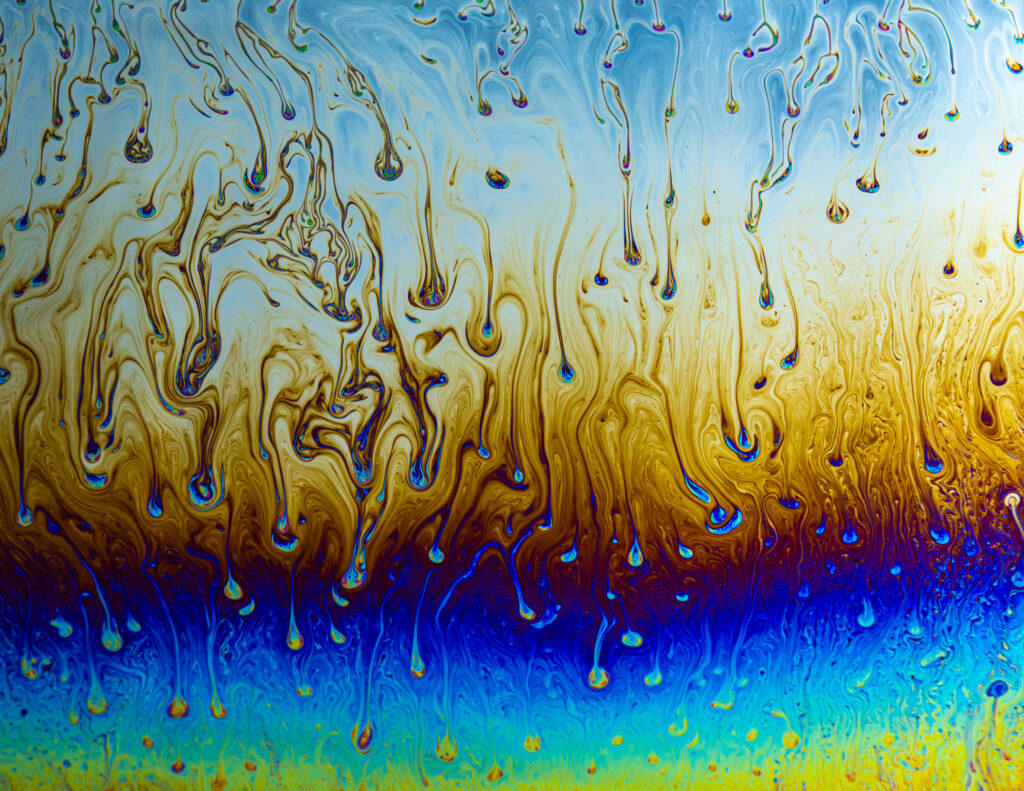
]]>To be able to explore what soap bubble photography could offer I had to devise a method to create a stable ‘bubble’. Running around with a camera trying to capture a soap bubble before it bursts would not be the most ideal method to capture the colours. The method would also have to take into account the ability to light the surface in a controlled way because the colours are derived by the reflection of light on differing thicknesses of soap film. As an example, the golden yellow is thinner than the blue.
I had initially explored creating a frame with plastic tubes or straws. I found that all stocks had dried up after the ban on the sale of plastic straws. The idea of disposable pens glued together was the first idea I tried. The results provided a framed sheet of bubble mixture so the concept worked. To improve the setup I recreated it in waxed paper straws with the addition of extra beams to support the frame so that it did not need to be held.
Lighting from above with the camera in front proved successful for getting images.
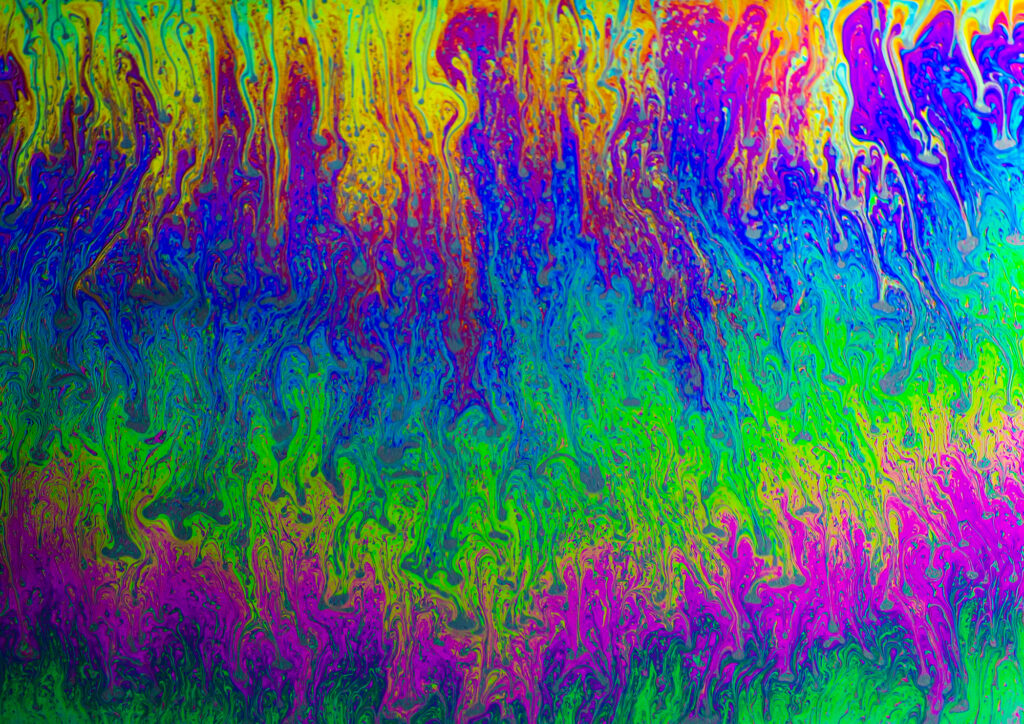
This produced some images that I was exceptionally pleased with, but it transpired that the method produced repetitive images. All very similar to each other. Gravity pulls the soap film down the constructed frame, and it is the relative thickness of the film where the colour comes from. After 100’s of images all similar, I abandoned the process for the time being. It will never create a collection of images with any real variation.
Other aspects that I am acutely aware of is that I am working on a flat plane. A soap bubble has a curved surface. This curvature would help improve variation to the images. Also working in close proximity to the sheet of the film provides a limited depth of field.
The post Soap Bubble Photography appeared first on MA Photographic Journey.
]]>The post Artist: Dieter Roth appeared first on MA Photographic Journey.
]]>Roth’s image from 1970 shown here is a screen print, which could question originality, however, I find keeps the eyes exploring the image for interest and exploration. The tones which only have a small range of colours, blues and orange-brown, offer such a great diversity of elements. The darker colours lifting away to create individual images before you plunge into the lower tones of the blue.
This I feel is an excellent example of abstract work because of the individual detail within the image with no representation or signifier within the image.

The Tate has a collection of his paintings and prints available to view online, I find that there is such great variation within the body of work. The ‘self-portrait at a table’ is a good example of the surrealist influence and then other works depict other styles, but the abstract theme underlies many of the work.
Bibliography
- Roth, quoted in Roth Time, Dobke and Walter, Lars Müller, 2004, p77
Figures
The post Artist: Dieter Roth appeared first on MA Photographic Journey.
]]>The post BA Presentation – Reflection appeared first on MA Photographic Journey.
]]>BA Presentation Reflection. Completely useless PDF if you were not present. The 20 mins of me orating to discuss, explain and reflect are missing. Ten more minutes of questions and answers which I felt were for my benefit. Thanks to Pe** I now have another avenue to explore. Thanks to Steph and Abby for finding some BA student willing to give up lunchtime.
LO6 Written and Oral communication was clearly fluffed. I know that I spoke too fast and maybe without a clear train of thought, so did not delve very deep into the images which would be the LO5 Critical analysis. Notes and more rehearsal. Maybe the practice which came in at 35 minutes caused the rush?
The experience has presented a strange position in that I have been reluctant to have my camera on during lectures and seminars during the modules, Not sure why. Here I was camera on, the mic on and the spotlight was very much on me. I have felt very conscious that there are others that stand out and I have been in the shadows, which sadly is not who I have been or think that I am.
I feel this experience was very much required for me to get back to being at the front. I would love to thank all the students that gave up their lunch time to drop in and hear R****** C********* and myself.
Although the contextualisation of other artists works presented in the chatbox was well known to me through the research I have undertaken it was really good to see how much the group were informed.
Some of the work I have undertaken is Pinhole, Justin Quinnell is well known for this kind of work and has presented a workshop on his practice, which I was unaware of. Finding out more about what the students have done would have stopped me from showing the can that I have used. However, this is really good in that it reinforces the research aspect of whatever you do.
I feel it is shame that more of the Informed Contexts group did not take up on the offer because this was far greater an experience if you reflect on your own performance within the learning outcomes
The post BA Presentation – Reflection appeared first on MA Photographic Journey.
]]>The post Quick Thought: Originals appeared first on MA Photographic Journey.
]]>With photography is that the negative? the SD card?
This could be perceived as a difficult area. I could produce an image, importing the image from the SD card into Photoshop or Lightroom and create the final product. I could develop a film then process the negative with dodge and burn and other darkroom techniques such as pushing the processing or other chemicals. Where is the original in this process?
If the original is the SD card then I have destroyed most of my originals. With the analogue process of film if no processing is done I feel the negative is the original, however I feel that any photographer of note has changed the image in the dark room.
I can accept that anyone in the analogue could produce an original print as they have created it from the negative. This process would not lead to a repetitive duplication. This also slides down the question of originality.
I suppose the negative as the original would stop any photographer producing more of the image, but my SD card lost damaged or sold would not stop that once imported.

David Neaves passed away several years back. His art is widely disseminated in part through the cafe and his own website. This image is the Windswept Hare This is most probably the top-selling image. On his passing, his widow provided me with a USB drive of files to recover some of his art. He used a MAC so no access to it. I can replicate his work in the original form. I have the PSD. What’s the original?
A question all of us need to consider not we move into this digital space.
As part of informed Contexts CRJ
The post Quick Thought: Originals appeared first on MA Photographic Journey.
]]>The post Week Nine: Peer Video Presentation Feedback & Reflection appeared first on MA Photographic Journey.
]]>Hi Roydon,
I find your project fascinating!
With your intent – maybe you could talk about what led you to change the images once you took them? Maybe you could talk about the colours you use and why you choose them? Also I think it would be interesting to see the image from start to finish – even just a ‘behind the scenes’ type of shot to see how you create the work because its not immediately obvious how the images are created, i.e. the images all seem finished, almost like a painting would be finished.
I know you don’t need anymore artists to look at as you have contextualised your work really well but your work makes me think of Patrick Heron and Mark Rothko’s work.
I also think that the exhibition idea is spot on – having the images nice and big. I don’t know if you have seen Roy Litchtenstien’s work in a gallery before but they are enormous pieces and really makes you understand his work more – as you said seeing this type of work in a book really doesn’t do it justice.
Hope this helps!
B**
Thanks, Ben for taking a look,
I have to agree that Rothko was left out. When I started it was only a couple of photographic artists then the research started revelling so many but I will gladly take more suggestions. I have not stumbled across Patrick Heron, but having viewed his work the cubism/surrealism is clearly visible before he dramatically moved into abstract expressionism.
I do like the point about the changing of the image and that is certainly something I will address.
The Tillmans quote about as soon as it is a photograph the question of how comes in. I am happy to share the method but do not see that it is important, it is the final image.
Thanks for some really good feedback
H**** W*****
Hi Roydon,
That certainly was a trip and I very much enjoyed it. I think the level of experimentation and technical prowess here were very strong though I feel the work sometimes lacked intent. I think it was well informed and contextualised through contemporary practitioners (LO3) with a good use of personal observations and critical opinions of your work and those practitioners (L06). I think for the dissemination of contemporary photographic practices could have used a few more examples of how those practitioners you gave as an example show their work and what platforms/mediums they choose to display the work to their audience (LO4). I thought the presentation was presented well though as with the work and you did acknowledge this that sometimes it went off on various tangents which I think is part of the experiment process which you acknowledged. I think with clearer intent such as the toxicity of plastic pollution on the beach or the reason why you made the photographs it would help navigate your way through the abstraction and have a reason why you abstract the work in the first place. The solar can image was very beautiful btw on another note and I know we’re not supposed to be thinking about (LO1) but I think the work of the abstract seascapes were particularly pleasing to myself.
H****
S**** R******
Thanks for sharing this work Roydon. Having worked with you on the last module and seen a couple of these images over the last couple of weeks it was great to see the wider scope of your work in progress. The vibrant use of colours and abstract nature of them makes them very unique and will I am sure come together as a powerful body of work.
I was a little unsure at the outset what your intent was in terms of this work but having then seen the discarded sauce bottle image and you thoughts and ideas around incorporating them with the more abstract I can see how this will work. I guess you will need to consider bringing this part in a lot sooner in terms of your critical review as it would be good to start with the overall intent at the outset.
There were some great example of photographers that have inspired you, big tick for LO3, and your images stand up well against them, confirming the contextualisation of your practice. LO1 is also very evident in terms of your awareness and expertise in experimenting and creating this wonderful images. LO4 is also evident in terms of the dissemination of your practice and I like the sound of the exhibition, I would suggest adding more details in about how this would look and perhaps incorporate the environmental pictures such as the sauce bottle to show how this would be included.
Whilst you have said in the words above that you have failed with LO5, there was evidence of critical analysing your work in terms of the multiple exposure shots and soap bubble images.
Looking forward to seeing more of this project in the coming weeks.
One fact that leaps out is that I introduce the pollution at the end of the presentation and it will appear that people focus on that aspect. I had thought that the citation of Wolfgang Tillmans would leave the viewer without any doubt is was about the individual picture. Another aspect that leaps out is the quote reflects on the concept that the method is not important, it’s the image.
The post Week Nine: Peer Video Presentation Feedback & Reflection appeared first on MA Photographic Journey.
]]>The post Week Nine: Peer Reviewed Video appeared first on MA Photographic Journey.
]]>Public Video (Do not use as a template for your own, its not been marked)
For the peer reviews visit the PHO702 Peer review feedback post
Part of PHO702 Informed Contexts Falmouth University MA Photography
The post Week Nine: Peer Reviewed Video appeared first on MA Photographic Journey.
]]>